


Grand Chorus Without End at the Old Cathedral in Jackson Square
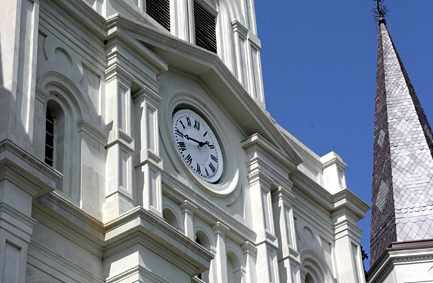
Every quarter-hour, the thin peal of bells at St. Louis Cathedral calls saints and sinners, mostly the latter. They clang out a slightly off-key sound, as if they well know the offbeat rhythms of the neighborhood below them. The pulse of a circus atmosphere around the church pounds from hour to hour, as if to compete with the timbre of the sounds from the tower. The church stands sentinel, nether judging nor joining.
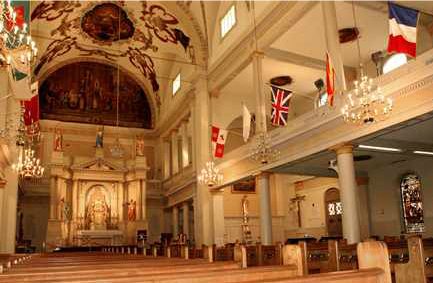
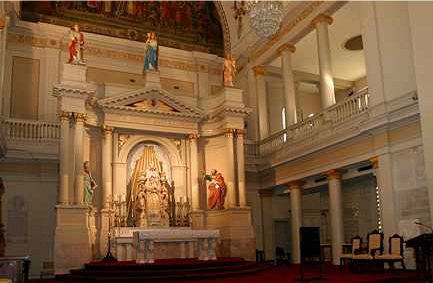
Inside, the aroma of ancient brick masonry greets the visitor. One thinks at once of an old French monastery, although stone is nowhere. The darkened entry gives way to a bright interior with painted surfaces everywhere. The eye is drawn to the great high Rococo altar, where gilded and fluted columns of the Corinthian order support a busy entablature. Two rows of wooden columns divide the church into nave and side aisles, with a mute upper gallery where, one imagines, crowds overflowed before Vatican II put an end to crowded churches.
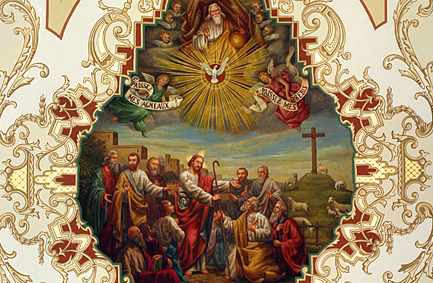
Along the walls, St. Louis lives through stages in multicolored shards of artist’s glass and lead. Here he receives a blessing from St Blanche, his mother; there he marries. He builds a chapel, receives the crown of France, and departs for his first crusade across a wooden plank. Further on he visits a leper with lesions of hollow glass, and in the great lunette over the high altar Louis announces the Seventh Crusade. Overhead, St. Peter receives his shepherd’s staff from the Savior, surrounded by apostles, as the Father oversees the mission.
St. Louis Cathedral Gallery
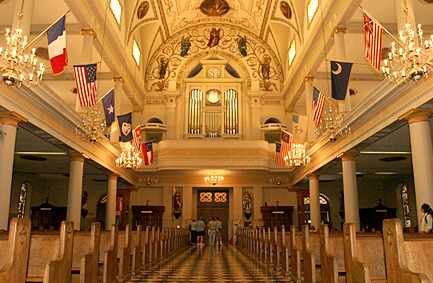

Pere Antoine, Bishops’ Bones, Unending Restoration
History, harmony, legend, and tradition preserve the mystique of this cathedral. By most counts it is the third substantial church of St. Louis on the square. The French built the first one in 1727, following the town plan. It stood, weathered, until the Great Fire of 1788, when Spanish dons were ruling. Rebuilt with funds from local notary and real estate developer Andres Almonester y Rojas, the second church barely escaped the flames of yet another general fire in 1794. It was mainly in that second church that the memorable Spanish Capuchin Pere Antonio of Sedella served from 1783 until his much-lamented death in 1829. Here lay the bones of old Don Almonster, and of the said Friar Antonio, for whom the people named Pere Antoine’s Alley alongside the church. Here was sung the Te Deum thanking God for the Victory of the Battle of New Orleans in 1815.
The Spanish church got its stripes when the city received its first bishop in 1793. Sixty years later, New Orleans became an archbishopric, elevating the cathedral further. The present building rose then, incorporating a few bricks and lines of mortar from its predecessor. The marguilliers or church wardens had it built from plans drawn in 1849 by French-born architect Jacques N. B. de Pouilly. Its iconic, multi-stage, tapering, slate-covered triple towers are better than any that preceded it.
Today the church contains the remains of eight New Orleans bishops. Their lives reflect the story of the Church and the city. Renovated, decorated and restored over and again, repainted inside and out, waterproofed, strengthened with steel, buttresses added, foundations fixed, the church stands. Today the St. Louis Cathedral is a symbol of New Orleans and a tribute to the people and clergy who have struggled to preserve it. Most of all it is a haven of serenity from the soul-splitting life of the world outside.
Sally Reeves is a noted writer and historian who co-authored the award winning series New Orleans Architecture. She also has written Jacques-Felix Lelièvre’s New Louisiana Gardener and Grand Isle of the Gulf – An Early History. She is currently working on a social and architectural history of New Orleans public markets and on a book on the contributions of free persons of color to vernacular architecture in antebellum New Orleans.

JOIN THE NEWSLETTER!
The Courts are Home Again on Royal Street
It took two years to build and two decades to renovate. To some it was an elegant City Beautiful triumph of slum clearance, to others an out-of-scale offense to an historic neighborhood. Home to landmark legal decisions and antique documents, it gave way to stuffed birds, mounted fish and rock displays. Increasingly beleaguered, empty and abandoned, it fell “tumbling into ruin.” Proposed as an opera house, casino parlor, tourist center, movie set, or better yet, for demolition, it soon housed live birds and real animals, nesting in the nooks of its ornate spaces. But now–with restoration costs approaching forty million – the “New Court House” on Royal St. is new again.
New in 1910, abandoned in 1958 for more modern quarters
Opening in 1910, it was the “New Courthouse Building” for most of its life in the rousing world of jurisprudence. Its purpose was to “clear slums” while replacing the Cabildo and Presbytere as the seat of local justice. For fifty years the Louisiana Supreme Court and a spate of lower courts and offices drew swarms of glad-handed politicians, judges and lawyers, plaintiffs and defendants, juries and commissioners, clerks and secretaries, librarians, and even an occasional historian through its sculpted hallways. But in 1958 the Supreme Court departed for newer quarters and others soon followed. The halls that had rung with homegrown political wisdom, argument and judgment, now fell silent.
But today the courts are home again. Marble floors gleam again, plastered walls are clean again, and tech-savvy secretaries have settled in the nooks of its cavernous and newly scrubbed spaces. Meanwhile, residents, glad to see the courthouse live again, remember what was lost to history to accommodate its construction.
Built on two squares heavy with history
In 1831 the fourth block of Exchange Alley cut the site into two small squares with numerous stores and houses. A trim row of granite-columned stores lined the Alley from Canal to St. Louis Street. Cafés, studios, and the offices of architects and surveyors filled the row with conversation, art and engineering. At the end of the last block, facing the St. Louis Hotel, once stood the storied “Café des Colonnes,” planned by the talented architect de Pouilly. On Royal St. the “Grand Old Creole” Bernard Marigny had the polished Henry S. Bonneval Latrobe design a pair of elegant houses. On the same block General Jackson met with advisors to plan the Battle of New Orleans. Here later was the home of Mollie Moore Davis, wife of the Confederate president.
By the turn of the twentieth century this was all ancient history. To the business class, the deteriorated Quarter was a hopeless slum in need of general razing. Meanwhile, the political class saw the dawn of a new day in the demolitions needed for the brand new courthouse. But even with a blank slate, architects Brown, Brown and Marya faced a challenge in the heart of the Quarter. The Court’s mass and pristine white Beaux Arts exterior would contrast sharply with the small-scale buildings and unpainted surfaces around it. The complex building footprint they designed addressed this issue by diminishing the mass and allowing for considerable buffering in the landscaping. In plan, a rectangle on the Royal Street side diminishes to a narrower passage, and then spreads out expansively as it approaches Chartres Street, its arms ending in graceful semi-circular apses.
Overall, the Supreme Court has been a friend to the Quarter. Its findings in landmark cases like Mayer and Pergament have confirmed the regulatory power of the Vieux Carré Commission repeatedly. With the Courts now home again, judges will see first hand what coming years will plead for in the Old French Quarter.
Sally Reeves is a noted writer and historian who co-authored the award winning series New Orleans Architecture. She also has written Jacques-Felix Lelièvre’s New Louisiana Gardener and Grand Isle of the Gulf – An Early History. She is currently working on a social and architectural history of New Orleans public markets and on a book on the contributions of free persons of color to vernacular architecture in antebellum New Orleans.
JOIN THE NEWSLETTER!
French Quarter Post-Katrina Photos
By: FrenchQuarter.com Staff
The New Orleans French Quarter after Hurricane Katrina looks pretty much the way it did before. Thank goodness. And residents and shopowners have been busy cleaning, polishing and sprucing up the old city for company coming. FrenchQuarter.com’s been on the streets taking pictures of Second Lines, psychics, artists, street sweepers and assorted characters who give the French Quarter its unsinkable mojo!
If you’re visiting the French Quarter, check out all of your options – here’s the list of open restaurants, hotels and shops plus their Katrina hours of operation.
JOIN THE NEWSLETTER!
Inspired by Decline: Old Quarter Feeds Creativity
If “the seed must die to generate new life,” it was the post Civil War demise of the old Creole society in the New Orleans French Quarter that gave rise to a world of romantic reminiscences about it. Those enigmatic Creoles– be they private, penurious, prideful in their poverty–left their indelible mark on the world they built. The sprit of what went before absorbed and co-opted those who came afterwards, those who inherited the remnants of the kingdom. Living with the dense, semi-fortified streetscape, a world of light and shadow known for withholding some of her favors, they came to grips with the sense that something about the place and the people was elusive. Thus was born the New Orleans fiction of George Washington Cable and Lafcadio Hearn, of Grace King and Kate Chopin, in the waning years of the 19th century. As historian S. Fred Starr has written of Hearn especially, they “invented New Orleans.” And if Creoles resented being probed and analyzed, ridiculed and fictionalized, perhaps it was because they were the un-self-conscious, uninvented, genuine article.
Time wore on and time wore down the neighborhood. No longer a place of grace and wealth, it became a place for the displaced, for the poor, the immigrant who lent his flavors to the heady mix of place and people. It all came together at the Old French Market, where the scenes and scents of vital life swirled into a piece with historic precedent. This was a place for those who were comfortable with a dense urbanism, risk-takers who found a little or a lot of dirt and disorder, clutter and confusion somewhat acceptable.
Nineteen hundred was the winter of existence in the life of the Quarter. Its people were as poor and as worn as its streets and its buildings. As the one-eyed, night-watching Hearn had recounted, the populace lived in warrens, washed food and body in courtyard fountains, and worked from dawn to sunset. But if the seeds of growth were buried, the earth was fertile. Photographers arriving in 1920 were as astounded to see it as archaeologists finding treasure. With careful lens they captured the Quarter as it emerged unretouched from its postwar decline. Scenes captured by photographers Tebbs and Knell of the 1920s presented a stark contrast to the polished views commissioned by the city in the work of Lilienthal fifty years earlier.
Writers and painters followed. The starving artist could find in the Quarter an inexpensive room with a picturesque view of rooftops looking like Left Bank Paris, piano music drifting upward, and kindred spirits, human and bottled, at every neighborhood corner. If it is a natural part of an artist to find virtue in decay and a sultry atmosphere, saints abounded. William Faulkner, writing from a Pirate’s Alley flat in 1925, composed this take on Jackson Square at nightfall:
“He opened the street door. Twilight ran in like a quiet, violet dog, and nursing his bottle, he peered out across an undimensional feathered square across stenciled palms and Andrew Jackson’s childish effigy….” – (Mosquitos, 1927).
Writers of the Twenties and Thirties flocked to the Quarter. Along with Faulkner, Sherwood Anderson, Ernest Hemingway, Thornton Wilder, Roark Bradford, Tennessee Williams, Truman Capote, Lillian Hellman, Lyle Saxon, and Hamilton Basso were among those who found their way to the Old Square of New Orleans for inspiration. They found it in peeling paint and shadowy, overgrown courtyards, in a heavily Black and ethnic population, in an environment where people lived out customs, found parts of day-to-day survival on the stoops of crumbing cottages, and valued old things, because in them, one found comfort.
Peeling paint and timeworn surfaces have given way to fun, food and entertainment. But the Quarter’s atmosphere of creativity has endured for residents and visitors. Try your luck with inspiration in a quiet corner. You just might be surprised to find it.
Sally Reeves is a noted writer and historian who co-authored the award winning series New Orleans Architecture. She also has written Jacques-Felix Lelièvre’s New Louisiana Gardener and Grand Isle of the Gulf – An Early History. She is currently working on a social and architectural history of New Orleans public markets and on a book on the contributions of free persons of color to vernacular architecture in antebellum New Orleans.
JOIN THE NEWSLETTER!
French Quarter Fire and Flood
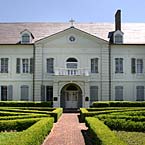
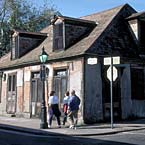
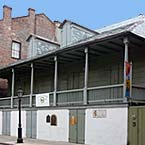
Top to bottom: Notable French Quarter Fire Survivors – Ursulines Convent, Lafitte’s Blacksmith Shop, Madame Johns Legacy
Of all the forces that conspire to destroy a city – time, storm, neglect, need – fire does the most harm. Without Prometheus, we might have more of our colonial city to preserve and savor. Two great fires in late eighteenth century New Orleans left the inhabitants few years to re-establish their institutions before the onset of American domination in 1803. Although several fine houses date to the last colonial decade, they and the French Quarter, including the Cabildo and the Presbytere, are conspicuously “Post-Fire.”
Looking at the vibrant, festive Quarter with millions of visitors annually, it is hard to imagine the devastation of Holy Saturday morning in 1788. Smoking ruins stretched from Chartres to Dauphine Street, and from Conti to St. Philip. The fire began on Good Friday morning in the home of Spanish treasurer Don Vincente Nunez at Toulouse and Chartres. It was a blustery March day, with the wind blowing out of the southeast (probably into a cool front). Within hours, over eight hundred homes and public buildings were reduced to ashes, including the church, the town hall, and the rectory on the Plaza de Armas. A saddened Governor Esteban Miro reported to Spanish authorities of the “abject misery, crying and sobbing” of the people. The faces of the families, he wrote, “told the ruin of a city which in less than five hours has been transformed into an arid and horrible wilderness; the work of seventy years since its foundation.”
The Second Great Fire
Rebuilding had scarcely begun when in 1794 a second fire and two hurricanes swept the city. The fire of December 8 that year burned 212 buildings – fewer, but more valuable. When both storms and both fires were all done, nearly all the public buildings, homes and businesses except those fronting the river had been consumed or badly damaged. Through it all the Ursuline nuns in their convent on Chartres Street had prayed to Notre Dame de Bon Secours, Our Lady of Prompt Succor, patron of Rouen, their home town. As the fire had neared the convent on that Good Friday, the wind changed suddenly. (As Providence would no doubt have it, the front arrived from the north just in time.) The convent survived, and is still here with us.
The results were fundamental to the Quarter. Baked tile and quarried slate replaced the roofs of ax-hewn cypress shingles. Buildings, set at the sidewalk or banquette, were of all brick, with common firewalls. The wide and shallow hipped roof, galleried townhouse perfected in the French period gave way to vertical, long and narrow Spanish-style town homes, many with overhangs, iron work and entresols or mezzanines. The Cabildo and Presbytere came into being. A new church rose from the ashes. A suburb opened on the upper side of town for residents wary of crowded Quarter conditions. Fire pumps were commissioned. The market moved riverside. Artisans were called in. Protestants gained a foothold. But people went homeless, the city indebted, and lives were lost to death or removal. The city was different.
Every Quarter Square Scarred by the Elements
Since the two Great Fires, Providence has not seen fit to visit the Quarter with any more all-points conflagrations up to the moment. But hardly a square in the Quarter has not had its smaller fires. And hurricanes keep coming. A great storm of August 19, 1812 swept away a brand new, year-old French Market building. Another in 1915 damaged the steeple of St. Louis Cathedral. The popular Orleans Theater and Orleans Ballroom burned in September 1816; rebuilt, the theater burned again in 1866. Fire damaged the Bank of Louisiana on Royal Street, today the home of the Vieux Carré Commission, resulting in the monumental columns installed in the remodeling.
Today, the French Quarter fire code is stringent. Motorized Mardi Gras parades are forbidden. Any Quarter fire signals an instant citywide fire alarm. The intent is to prevent fires from spreading. Still, the most important fires of the Twentieth Century occurred at individual structures. Social historians consider the burning of the Old French Opera House on Bourbon in 1919 the “final nail” in the coffin of the old Creole culture in the Quarter. But others espoused that culture, treasuring its memory. When the Cabildo burned in 1988, two hundred years after the First Great Fire, citizens felt the loss keenly. Carefully restored, it stands a proud reminder of a city’s resolve to safeguard its heritage.
Sally Reeves is a noted writer and historian who co-authored the award winning series New Orleans Architecture. She also has written Jacques-Felix Lelièvre’s New Louisiana Gardener and Grand Isle of the Gulf – An Early History. She is currently working on a social and architectural history of New Orleans public markets and on a book on the contributions of free persons of color to vernacular architecture in antebellum New Orleans.
JOIN THE NEWSLETTER!
Some Liked It Hot: Open-Hearth Cooking In Emerante Hermann’s 1830s Kitchen

Come see the open-hearth cooking demonstrations at the Hermann-Grima House
Nineteenth century foodways are on the menu Thursdays in season at the open-hearth kitchen of the historic Hermann-Grima House on St. Louis Street. Where Samuel and Emerante Hermann’s enslaved cooks Charlotte and Sarah once dished up Creole cooking in the 1830s and ’40s, trained volunteers now fire the coals under swinging cranes suspending smoked hams and spiced sausage. Carefully, they recreate the cooking procedures of the open hearth, the “beehive” baking oven, and the “potager” or “stew holes,” a brick-surfaced cavity capable of simmering gumbos, stews, and red beans. On the large rotisserie of the open hearth, volunteers roast ducks, chickens, geese and beef, or place meats in a “tin kitchen,” an up-to-date gadget of the 1830s. The curved tin contraption made roasting easier for early cooks by reflecting heat from the fire and catching juices. One could also comfortably baste meats through a door in the rear. Right in the fireplace, one could also cook “down hearth” on a short-legged grill, or bake soda-leavened cornbread in a lard-greased Dutch oven.
The cooks bake bread loaves—whether French, round or brioche—in the great walled oven. An experienced cook can use the arm to test when the oven heat is ready, counting seconds at the rate of “one potato, two potato.” At a tolerance of “ten potatoes,” the oven is ready for the loaves to be baked right on the floor inside (presuming the arm has been extracted). The simple dough of flour, yeast and water, with a small pinch of salt or sugar and a dash of milk, is inserted on a paddle. The cook may also swab out the oven with a water-dipped cloth, depositing the moisture needed to crust up the French bread.
What’s good at the Market? Beef for sale, 3¢ a pound
Servants of Creole families shopped for meats, vegetables, and fruit each morning at the old French Market. Until early in the twentieth century, the highly regulated public market was the only location in the Quarter where butchers and vendors could legally sell meats and other perishables. Sunday morning market days were busiest and most appealing for socializing, as shoppers purchased items for the sumptuous noon meal. More than beef, veal, lamb or pork, mutton was a highly prized item. Early in the 19th century, beef was poor, but cheap, at 2-3¢ a pound. One could purchase a pair of hens, chickens, capons, geese or ducks for 60¢ to $1.40. Two large turkeys cost $4.00, and eggs were about 20¢ a dozen. Market hunters supplied deer, snipe, partridge, mallard, teal, quail, rabbits, hare and the tasty red squirrel that feasted on live oak acorns.
“First class” fish from Lake Pontchartrain—including trout, eel, redfish, and perch, cost 6 to 9¢ a pound. Fishermen sold the more common river fish, probably cats and Tchoupic or mudfish, directly from their boats at a cheaper price. Other seafood in the market included oysters at 50¢ per hundred, crawfish at 11¢ for 20, and shrimp at 11¢ for 30. As early as 1800, the shopper could choose kale, green beans, tomatoes, leeks, Havana bananas, apples, peaches, plums, figs, and pomegranates at 11¢ to 20¢ a bunch.
A great pastime of shopping was drinking chicory café au lait at marble-countered market stalls. Chicory is the roasted and ground root of chicoroium endiva, which probably came into use in New Orleans about 1820, soon after the French began to grow it in Paris market gardens. Englishman Charles Lyell’s writings about the French Market in 1856 still ring true: “There were stalls where hot coffee was selling in white china cups,” he wrote, “reminding us of Paris.” New Orleans people still drip their coffee slowly in French biggins, and flavor it with chicory. Don’t go home without it.
Open Hearth Cooking Demonstrations are part of the guided tours offered Thursdays at the Hermann-Grima House, 820 St. Louis Street. 504-525-5661.
Sally Reeves is a noted writer and historian who co-authored the award winning series New Orleans Architecture. She also has written Jacques-Felix Lelièvre’s New Louisiana Gardener and Grand Isle of the Gulf – An Early History. She is currently working on a social and architectural history of New Orleans public markets and on a book on the contributions of free persons of color to vernacular architecture in antebellum New Orleans.
JOIN THE NEWSLETTER!
Is the French Quarter French? Or Spanish?
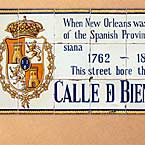
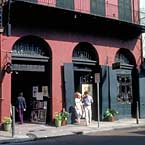
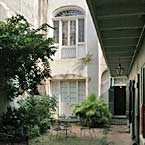
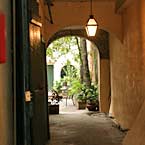
Spanish Influences: Memorial Signage of Original Spanish Street Names, Arched Entresol Building Design, Mezzanine & Courtyard View, and a Covered Courtyard Entryway
The age-old battle between the French and Spanish influence on New Orleans lives on. An intellectually savory argument, like angels dancing, it has fewer participants than in earlier decades when legal scholars contested the French-or-Spanish sources of the Louisiana Civil Code like knights in armor. Today the rivalry between the colonial powers lies mainly in analyzing French Quarter buildings and lifestyles. People ask: is the French Quarter French or Spanish? The arches and courtyards, the funny-looking “in-between floors,” the iron lace galleries, the café life and cooking ways-whose gifts were they? It is a subject for a café au lait at the market or a Sazerac at Napoleon House. After a few of those, the discussion can get heated, particularly when one’s know-it-all brother-in-law claims all the answers.
We confess that the French could have done a better job in the 18th century when the colony was theirs to win or lose. They chose to lose it, but the people chose not to be abandoned. Settlers clung to their French-born language and customs like moss on oak trees. From Paris they ordered all the latest editions of the golden age of Louis XIV and the French Enlightenment, filling their libraries with little 7-inch duodecimo sets of Racine, Moliëre, Voltaire and Rousseau. After forty years of Spanish dominion, they were still cooking with butter, marrying their cousins, avoiding their Easter duties, raising cattle with curious names like Fronzine and Bélizaire, and upholstering furniture with blue and white stripes in the Béarnaise fashion. They still had civil law, Mardi Gras, coffee dripping, the family meeting, sour oranges, sugar cane, Sunday dancing, and heavy gambling. They started drinking chicory coffee soon after French market gardeners began supplying the root of chicorium endiva to Parisian markets. Butchers at the public market-built by the Spanish-were so exclusively French that people began to refer to the French Market, in the “French” part of town, an institution left by the Spanish but built by Creoles and designed by a French native. The Quarter’s par terre gardens continued in the French style with flowers in the middle and walkways on the boundaries. The modern taste for a grassy lawn was either unheard of or an American malady.
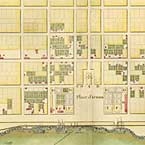
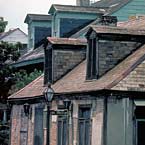
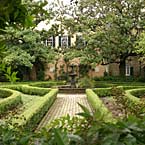
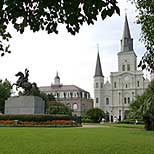
French Influences: City Planning, Creole Cottages, Parterre Gardens, and a City Square ‘Overlooked by Church and State”
But forty years of Spanish dominion left the French Quarter with a semi-fortified streetscape ready for fighting the forces of evil, with phalanxes of common-wall buildings, mysterious alleys, and secluded patios. If the Spaniard’s flat-topped tile-roofed buildings worked better in Sunny Spain than in wet New Orleans, there are still a few out there on kitchens and privies to puzzle the visitor. The Spanish gave us the St. Louis cemeteries, St. Charles Avenue, the first Catholic bishop, olive oil cooking, jars in the courtyard, entresol buildings with mezzanine spaces, Pere Antoine-who was really Friar Antonio, and Baroque-looking government buildings. They also left that queer legal pleading, the non numerata pecunia, sent from the wise Alfonso in the thirteenth century. This rule specified that if the notary did not see money change hands during the course of a mortgage contract, the lender had to renounce his right to sue about it later. The burden of proof fell on him to demonstrate the debt’s existence in alleging non-payment.
Foundations laid by the French and Spanish in the 18th century survived to shape the course of history in the city. The city plan, the central square overlooked by church and state, French arpents, city lots, faubourgs, heavy trusses, Creole cottages, the old Convent, and Charity Hospital came from the French side. But streetscapes full of repeating arches, Arabesque ironwork, covered passageways, and the still-alluring sense of guarded privacy came from His Catholic Majesty of Spain, not His Christian Majesty of France. If it all sounds confusing and unresolved, we invite your opinion. See you at the café?
Sally Reeves is a noted writer and historian who co-authored the award winning series New Orleans Architecture. She also has written Jacques-Felix Lelièvre’s New Louisiana Gardener and Grand Isle of the Gulf – An Early History. She is currently working on a social and architectural history of New Orleans public markets and on a book on the contributions of free persons of color to vernacular architecture in antebellum New Orleans.
JOIN THE NEWSLETTER!
French Speaking ‘Hommes de Couleur Libre’ Left Indelible Mark on the Culture and Development of the French Quarter
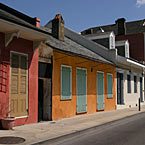
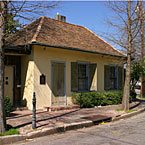
Top to Bottom: 933 Rue St. Philip, home of builder and community leader, Jean-Louis Dolliole; 1440 Rue Bourbon, another home built in 1819 by Dolliole
Jean-Louis Dolliole, 19th century builder and community leader, was the son of a Provencal Frenchman and Genevieve Laronde, a mother of African heritage. As a French-speaking free person of color or homme de couleur libre, Dolliole played an important role in developing and maintaining the culture and traditions of New Orleans. Serving also as testamentary executor, legal tutor or sponsor for friends and relatives, he helped to maintain the family lives and stature of the free black community. Best known as a talented builder along with his brother Joseph, Dolliole applied his skills to the creation of homes built and framed in the “French-style.” Using local materials like orange-red country brick and wood of cypress or pine, he drew largely on French building methods such as the triangular roof truss, half-timber construction, and the use of shingle, slate, or hook tile roofing or over lathing strips to fashion rooflines. Dolliole’s home in the French Quarter at 933 St. Philip represents the best of vernacular architecture. Built in 1805 and owned by Dolliole for a half century, it was rescued from near ruin by a skilled local architect and his wife, an historian and educator. And steps from Esplanade, Dolliole’s masterpiece at 1440 Bourbon stands on an irregular lot that reflects the crazy-quilt angles of the Faubourg Marigny. Here in 1819, Dolliole assembled the haunting lines of a softly-colored plastered brick cottage with a kaleidoscopic, double-pitched hipped roof of enduring flat tiles. To this day, the house is one of the most picturesque in the city.
Jean-Louis Dolliole was one of thousands of free people of color whose legacies survive in neighborhoods, church life, business, politics, music, writing and Francophone culture. Their records abound in local archives, dating from the 18th century until the Civil War and later. Among important builders were Pablo Cheval, Paul Mandeville, Bazile Dédé, August Philippe, Francois Darby, Charles Dupard, Manuel Moreau, Francois Boisdoré, Louis Barthelemy Rey, the Dollioles, Toby Dominique, Mytille Courcelle, Francois Fils, Florville Foy, Pierre Rillieux, and Joseph Chateau.
Joseph Chateau was one of the most prolific free black builders of the ante bellum period. His work has significance in a number of areas. New Orleans notaries of the 1840s recorded seventeen contracts documenting his building activities. Chateau’s stock-in-trade was the Creole cottage with a façade that was scored or floché to resemble stone, with decorative, red-hued painting. He also worked in other genres, building townhouses, renovating a store on Chartres St., and making innovations to the vernacular cottage. He responded creatively to his clients’ needs, such as getting a workable house built on a extra narrow lot, creating attractive rental property, tweaking space and a deeper footprint out of the traditional gable-sided cottage, and keeping up with fashion trends while preserving tradition. Chateau could also do drafting. While less than one per cent of building contracts have plans attached, over half of his have drawings, mainly floor plans that he executed with sophistication, and several with elevations.
Another profession, one called “merchant tailor,” was a niche and springboard for free men of color. Importing luxurious ells of silk, linen and Belgian Limbourg cloths, they fashioned high-style frock coats, cravats, vests, and pants for fastidious gentlemen, maintaining well-appointed storefronts with numerous employees. Several turned their profits into real estate investments. While still in their thirties Chartres Street merchant tailors Julien Colvis and Joseph Dumas owned 5 houses in the French Quarter, 21 in Tremé, 3 in the Marigny, 11 in the St. Mary Faubourg, and one in the town of Mandeville. On the same street, tailors Etienne Cordeviolle and Julien and Francois Lacroix amassed a fortune, and citywide holdings. Bourbon St. tailor Louis Barthelemy Rey formed a partnership with the land developer Victoria Lecesne. Victoria was wife of a man named Chazal Thomas, but identified her separate property in business dealings. It was not uncommon for free women of color to engage in business or build their own homes. Francoise Fusillé, Marie Laveau, Modest Foucher, Madeline Oger, Charlotte Morand, Rosette Rochon, Eulalie Mandeville, and Helene Toussaint, were among the many who records show built homes or engaged in business.
Today the spiritual heirs of the likes of Jean-Louis Dolliole, and Joseph Chateau celebrate their accomplishments. The old French names live on in their communities. Their legacy lives in the city’s fabric.
Sally Reeves is a noted writer and historian who co-authored the award winning series New Orleans Architecture. She also has written Jacques-Felix Lelièvre’s New Louisiana Gardener and Grand Isle of the Gulf – An Early History. She is currently working on a social and architectural history of New Orleans public markets and on a book on the contributions of free persons of color to vernacular architecture in antebellum New Orleans.
JOIN THE NEWSLETTER!
Vintage Bourbon Street Burlesque
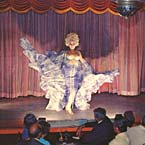
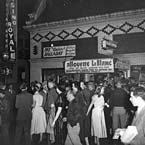
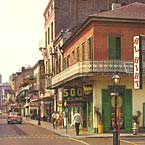
New Orleans in the Forties and Fifties was often heralded as “The Most Interesting City in America.” Bourbon Street was its epicenter, and it became world famous for its concentration of nightclub shows featuring exotic dancers, comics, risque singers, and contortionists, backed by live house bands. Along a five-block stretch, over fifty acts could be seen on any given night. The street gleamed with neon lights as barkers enticed tourists and locals into the clubs to see the featured attractions whose photographs were prominently displayed in the large windows outside. Clubs included the 500 Club, the Sho Bar, and the Casino Royale. It was a glamorous street where men and women dressed in their finest to take in a show.
New Orleans has a history of appealing to the carnal senses. Storyville, the famed red-light district at the turn of the last century, was known for its many houses of prostitution as well as being the birthplace of jazz music until it was closed down in 1917. After vaudeville, and the success of burlesque, striptease became a mainstay on the nightclub stages. In the Forties, stripteasers were in it for the money, as servicemen passed in and out of town looking for a good time. But, as “Stormy,” one of the most popular Bourbon Street dancers at the time said in Cabaret magazine, “Anything you do–no matter what it is–if you do it well enough, can be lifted to an art.”
A competition formed between the club owners to see who could draw the biggest crowd and make the most money. Girls competed with each other by creating acts based upon elaborate themes. Imagination was always the key even as props, beautiful costumes, mood lighting, and original music were incorporated into their acts. This only enhanced the natural beauty and talents of the girls. There were a bevy of exotic dancers like Lilly Christine the Cat Girl, Evangeline the Oyster Girl, Alouette Leblanc the Tassel Twirler, Kalantan the Heavenly Body, Rita Alexander the Champagne Girl, Blaze Starr, Linda Brigette, the Cupid Doll, and Tee Tee Red.


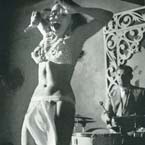
The young beauties of Bourbon Street gained star status. They had their own hairstylists, maids, assistants, agents, and managers. They mingled with visiting celebrities. Some exotic dancers were given small roles in films. Lily Christine the Cat Girl graced the cover of dozens of national magazines, and appeared in a few movies. Considered the top attraction on Bourbon Street, she performed at Leon Prima’s 500 Club. Musician Sam Butera, who worked with “the Cat Girl,” recalls her popularity, “One time they had a hurricane threatening. People were standing outside the 500 Club a block long waiting to get in. That’s how popular she was. With a hurricane warning!”
Controlled publicity was a convention of the time on Bourbon Street. Some clubs promoted their stars by putting their images on drinking glasses and postcards. Some of the dancers had drinks named after them. Getting arrested on obscenity was always good for a headline in the newspaper. A few exotics from Bourbon Street staged elaborate catfights or public displays that landed them spreads in LIFE magazine, the most-read magazine in the country at the time. Blaze Starr became quite famous for her affair with Governor Earl Long. The nationwide scandal became the focus of her autobiography, which later became the basis for a major motion picture.
The French Quarter had a seamier side. Pimps, prostitutes, criminals, and mob figures inhabited the Quarter. And B-drinking, in which strippers tempted men to buy them drinks for a cut of the profit, was rampant–and illegal. And, since everyone dressed up to attend a show, the girls often didn’t know if they were sitting next to a wealthy oil man, or an oily thug.
Politicians courted their own doom by enjoying themselves in the clubs, and it was ultimately their undoing that brought down the final curtain on girlie burlesque. During the 1960s, New Orleans district attorney Jim Garrison “cleaned up” Bourbon Street. The clubs were raided, and girls were arrested for charges of B-drinking and obscenity. To cut costs, the club owners first got rid of the bands, and replaced them with records. The sexual revolution of the Sixties eventually brought in go-go dancers, porn films, and strippers whose acts focused on flesh more than flash. Top musicians like Al Hirt and Pete Fountain survived, but the great burlesque queens of the 1950s did not.
For show dates and times, visit www.bustoutburlesque.com. Times Picayune theater critic, David Cuthbert says, “‘Bustout Burlesque’ has authenticity, electricity, and lubricity. It’s a fun night out to savor the lost art of the striptease, lovingly re-created and performed by gloriously good-looking girls who are oh, so naughty, but oh, so nice.”
Rick Delaup is a native of New Orleans, and the creator of Eccentric New Orleans and producer of Bustout Burlesque. He graduated from De La Salle High School, and spent a year at L.S.U. in Baton Rouge before going to film school in Chicago. He graduated from Columbia College in 1990 with a B.A. in Communications with a concentration in documentary filmmaking. He is an independent producer on a mission to tell the true, uncensored stories of real New Orleans people.
JOIN THE NEWSLETTER!
Still We Rise Again
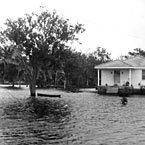
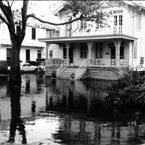

Images taken by the U.S. Corps of Engineers following Hurricane Betsy 1964
Aged and weathered cities all have their darkest hours, but somehow the ruins get better. Rome is still beautiful and has lived to tell the tale of its sackings by the Gauls, the Goths, the Vandals, the Ostrogoths, the Normans, and even a Renaissance Spanish army. The late Leonard Huber tells us that on the lower Mississippi river, thirty-eight floods occurred between 1735 and 1871 and nine of these inundated New Orleans. A levee break or crevasse in Kenner, he tells us, “brought water as far as Chartres St.” in 1816. The Sauve crevasse in 1849 “flooded 220 squares and drove 12,000 people from their homes.” The great crevasse at Bonnet Carre in 1871 propelled so much water from the river into Lake Pontchartrain that when a north wind blew the water toward the city, the Hagan Avenue levee broke and the city flooded. Still we rose again.
New Orleans has the distinction of flood threat from river, lake, and rainfall. The devastating hurricane of 1915 pounded the town with 120 mph winds, which segued in the next two weeks into 22 inches of downpour. The “Good Friday” rain of 1927 dumped 14 inches in one day while lightning disabled the power train to several pumping stations. The flood that year in the Mississippi Valley propelled the federal government to assume control of the river’s main line levees and install the Bonnet Carre Spillway to protect the city. Forty years later, four Times-Picayune reporters trumpeted in 1964 that New Orleans had not had a major (river) flood in a century, the year before Hurricane Betsy hurled 150 mph winds over the city, sinking ships in the river and topping the levees in the lower city and St. Bernard Parish. Although seven feet of lake water covered these areas, they still rebounded.
Disease, fire and mayhem?
If floods haven’t killed us, what about disease, fire, and mayhem? Again, Huber tells us that yellow fever struck twenty-three times before 1860, killing some 30,000 citizens. Asiatic cholera, especially in the 1830s, sent souls to their maker at a rate of nearly a thousand a month for a two-year period. People were buried in trenches, entire families taken, and carts for the dead piled high and in as short supply as housing in the flood zone. Four-fifths of the city–including the provision warehouses–burnt to the ground in 1788, leaving the citizens homeless and hungry. When the Irish merchant and American patriot Oliver Pollock delivered a shipload of flour and medicine to the city at regular prices, Governor Esteban Miro was so grateful he gave him a trading monopoly. Pollock later bought Elmwood Plantation with his business profits.
Those who count the Katrina aftermath as our darkest hour might consider 1794, when a hurricane struck on August 10, another brought rain and flood on the 21st, and the city (then just the French Quarter) burned a second time on December 8, followed by looting. Governor Carondelet faced the desolation without FEMA to blame or complain about and without America coming to the rescue with troops and billions of dollars. But the city rose again.
Our founders were not unaware of the “topographical challenges” to their early settlement. But at fourteen feet above sea level, with a ridge of land along Bayou Sauvage connecting it to the lake and thence to the Gulf of Mexico, the site of the Vieux Carre looked promising in 1718. All things being relative of course, it was promising in contrast with the cypress swamps that surrounded it, giving rise to 19th century street names like Marais (swamp, quagmire), the old name for the modern street alongside the Superdome. Need we say more about that? Accordingly, the first suburbs clung to the river, the Faubourgs St. Marie (1788) and Marigny (1806) being only seven to ten blocks deep as late as 1850. As the city grew upriver and the plantations one by one began to subdivide, they drew their rear lines at about Freret St.–the present uptown border of Katrina’s infamous crusty brown water line.
Technology, topography or human willfulness and spirit
Technological progress in the 20th century for the first time made all 200 square miles in the city limits “inhabitable,” including the Ninth Ward. The formidable A. Baldwin Wood pumping system went on line in 1908, after which the city’s growth was “freed” of its topographical limitations. Citizens now refer to “The Pumps” like benign relatives, like a set of uncles looking after us. It is well to note that it was not the pumps that failed us this time. The recent disaster still tested the assumptions of the 20th century, leaving those of earlier periods undamaged.
The issue now is whether the community should rely on engineering, topography, or the human ability to rise from the ashes whatever the catastrophe. If we follow the example of our forebears, the answer is obvious–build raised houses behind levees on higher ground and expect the next disaster. A favorite local icon is the sight of a ship riding in the river about twenty feet above the street leading to it. It reminds us that we live with danger. And we know we will rise again.
Sally Reeves is a noted writer and historian who co-authored the award winning series New Orleans Architecture. She also has written Jacques-Felix Lelièvre’s New Louisiana Gardener and Grand Isle of the Gulf – An Early History. She is currently working on a social and architectural history of New Orleans public markets and on a book on the contributions of free persons of color to vernacular architecture in antebellum New Orleans.